 Studio Waldenstroem
Thema: Raumakustik
DIY QRD Diffusers (ReadScapeS)
ReadScapeS: DIY QRD Diffusers
N-number
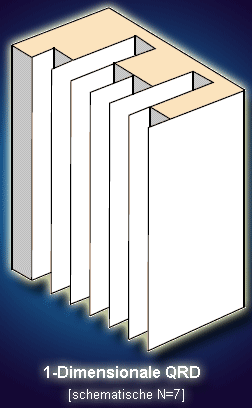
Below and on the right you find examples of QRD diffusers.
QRD = Quadratic Residue Diffusor
The simplest yet very effective QRD diffusers have 7 wells’. That’s why it’s called ‘a QRD-7’.
One complete pattern of [N =X] wells is called ‘a period’. Any diffuser configuration on the wall or ceiling should consist of *several periods.Periodicity** is required to generate homogenous diffusion.
Apart from N=7 other N-numbers exist. Have a look at the table on the far right.
The word “reeks” means ‘sequence’.
**In this case:** **depth* sequence.
The N-series, up to number 31, is made up of QRD diffusers with growing complexity : N=7, 11, 13, 17, 19, 23, 29, 31…**
These will be diffusers in which 1 period consists of 7, 11, 13, 17,19, 23, 29 or 31 wells.
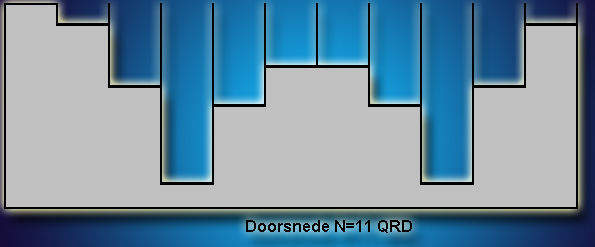
Below: a QRD-11
above:
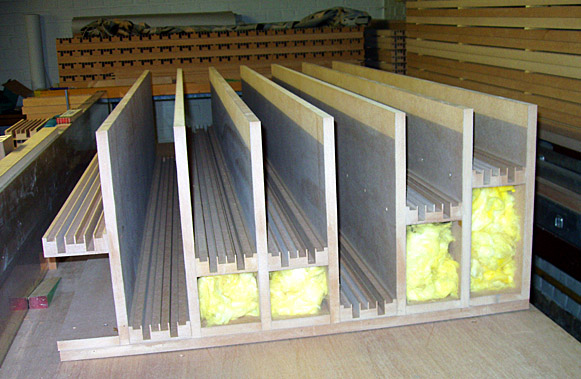
fractal DIY diffuser - QRD-7 6/7 Mod.2
a scaled QRD-7 is embedded in each well of the bigger diffuser, doubling the top end of the working range;
the 0-well has a negative depth number here (M=2)
it is** deeper **than the front of the fins and the diffuserfront itself
this results in a QRD-7 with a
deeper low end of the working rangewhen compared to a ‘normal’ QRD-7 in which** **M=0*.
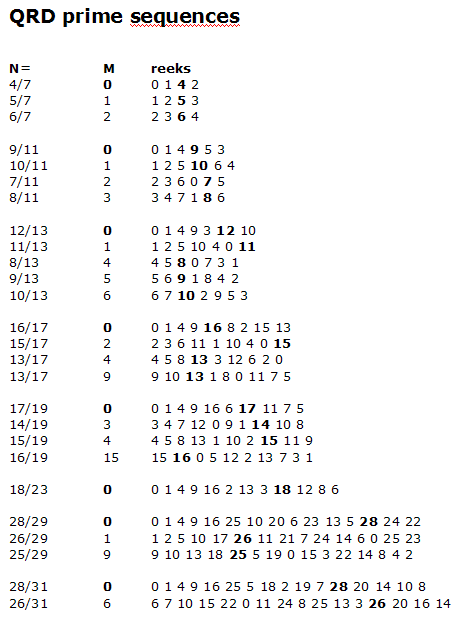
what does the M-number mean in this table?
The M-parameter defines the (relative) depth of the (odd) 0-well. This 0-well is the left well in both diffuser images on the left.
“M” means ‘modified sequence number’
M=0 always represents the
unmodified depth sequence **for the N-number in the first column. For the M=0 diy diffusers preposed on this website the physical depth of the 0-well is, of course, 0 cm.
Have another look at the QRD’s (drawings + photo) on the left.
A depth of 0 cm will correspond to the
**front of the fins and therefore with the front surface of the diffuser itself.In a QRD-7 6/7 mod.2 (photo left) this depth is no longer 0 (front of fins) but 2, a relative, negative **number on which the other depths in the sequence are based.
With a QRD-11 8/11 mod.3 this (relative) depth would be 3.
When looking at the M-sequences**within a single N-number (i.e. QRD-19), you will see the order of these sequences greatly differs. So wil the modes of construction. An M=>0 diffuser usually requires more labor and has more constructive challenges in the assembly. Challenges further increase if you also want to fold the deepest well, as is the case with the most efficient version of the QRD-7, the FWD-diffusers found HERE **on this site.
In the end the 0-well will also determine the diffuser depth, as well as the amount of wood you need to build it.
If you would calculate the working ranges of various M-sequences
**within one single N-number, relatively small differences will emerge in the lower and upper limits of those ranges.
The total working range (4 octaves in a QRD-7) will NOT change by changing the M-number.
The total working range, as a whole, will shift up- or downwards with the changing M-number.
Practically speaking:
**The reasons stated above do not really justify construction of diffusers with a 0-well larger than 0, unless you want to realise** the deepest possible low end limit within one single N-number. In that case you should build the diffuser according to the sequence (reeks) that will result in the lowest bottom end frequency.
good-to-knows…We must get a bit technical now, in order to better understand QRD design.
The N=number, the well-width, the maximum well-depth and the chosen depth-sequence (M-number) are essential designparameters for any QRD diffuser.
For a more technical and detailed article on design and designparameters you may read:
“Evaluating specifications and characteristics of QRD-Diffusers“](https://dngmns.home.xs4all.nl/rs_evaluate-difs_uk.htm)**. This article, in conjunction with the one you are reading now, has everything there is to know about simple yet very efficient acoustic diffusion at home.
-
The N-number of the diffuser defines the number of wells per period.
The higher the N-number, the wider the working range will be.
A correctly designed QRD-7 has a maximum working range of 3,75 octaves, regardless of any choice of other design parameters. -
Well-width defines the upper frequency limit of the working range.Narrow wells will result in a high upper frequency limit.
This parameter is inextricably connected to the chosen N-number: identical well-widths will result in different upper limit frequencies when a different N-number is chosen. -
The maximum well-depth defines the lower frequency limit of the working range.**
Deep wells will result in a low bottom-end frequency limit.
This parameter is also connected to the chosen N-number:
identical maximum well-depths** will result in different lower frequency limits when a different N-number is chosen. -
The chosen depth-sequence (M-number) defines depth and order of the various wells.
**Each N-number is accompanied by various depth-sequences. Each of them will result in a slightly different working range, which always has a bandwidth of 3,75 octaves max.
Some N-numbers have only 2 or 3 depth-sequences, others have 6 or 7, as you have read in the table with prime sequences.
A designer chooses one of the available depth-sequences within a given N-number.
Limitations…To put it bluntly:**
One cannot combine very narrow wells (to obtain a high upper frequency limit) while at the same time make those wells very deep so you can achieve a deeper low-end limit of that working range.**
It would be nice to create a very wide working range this way, but it will not work out fine…
The thing is, within those very narrow and very deep wells new unwanted reflections, resonances and coloration will originate, making the whole assembly quite useless for diffuser purposes.Correct proportions between well-width and maximum well-depth must be resprected to get a succesful diffuser design, and therefore these proportions are a crucial design parameter.
This proportion is related to the chosen N-number.With a QRD-7 and a PRD-7 the proportion is 1:4 maximum.This will result in a 100% efficiency benchmark that corresponds, with a QRD-7, to a working range of 3,75 octaves.
A PRD-7 has a working range of 3,25 octaves at 100% efficiency.For example: if you choose to apply a well-width of 5 cm, the maximum well-depth will than be 5 x 4 = 20 cm.**
If 20cm wouldn’t suffice to meet a planned bottom-end of the working range, you can choose a higher max. well-depth of, let’s say, 30cm.
**30 cm divided by 4 results in a well-width of 7,5cm which, in turn, will result in a significantly lower limit for high frequencies.
Yet in both cases we’re dealing with a design of 100% efficiency. Only the working ranges shift, defined by either well-width or max. well-depth. Choosing one always has consequences for the other.
**Plan - exampleOn the right** an example of a QRD-7 plan.
Reading and interpreting it is probably no problem now, when you have read this article up to this point.The deepest well* in this example has been folded once to save space and materials, yet the specs remain the same, with or without folding.
This model is the FWD-36 diffuser, part of a family of diffusers found elsewhere on this site.
This -36 is a fine allround diffuser!
Anti-flutter strip or Diffuser?An FWD-36 diffuser has a well-width of 36mm, making it an allround diffuser with regard to the working range. When the well-width of a QRD-7 drops under 25mm
**it shouldn’t be called a** diffuser anymore. A well-width of 25mm or less positions it in the category of “anti-flutter strips” **of which 2 exponents are shown on the right, a bit upward.
These are not really diffusers, because their working range far exceeds the part of the frequency spectrum where the fundamentals are found (which is up to a little over 4kHz / c5 on the piano)**
A well-width smaller than 25 to 30mm will position the upper frequency limit of a QRD-7 a lot higher than the top-end of the fundamentals range (a little over 4000Hz.) Such a QRD-7 can do wonders in eliminating
local flutter-echo and other high pitched reflection problems that are often a local phenomenon in a given room.
Such acoustic aids are referred to as “anti-flutter strips”.
The width of the
fins - 6 and 4 mm combined in this example plan - should never exceed 1/4 of the well-width. Changing one dimension in the design will always have an influence on other dimensions. Some of them can be successfully compensated, like the width of the top- and bottom plates or even the backwall.
Other dimensions, most likely the maximum well-depth**, can get compromised, depending on the part(s) you plan to modify.
Better also read the technical article, proposed here earlier, before trying to alter a design.
**TOP
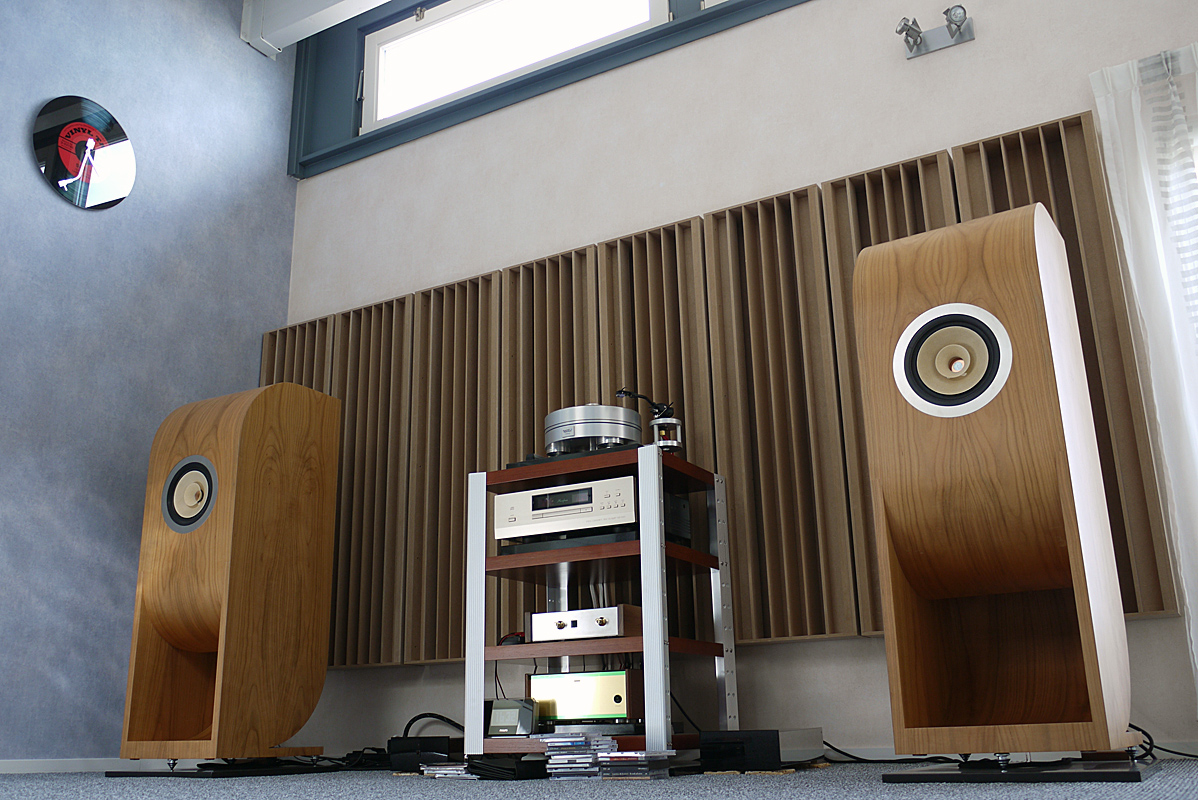
D I Y diffusers can be very rewarding…
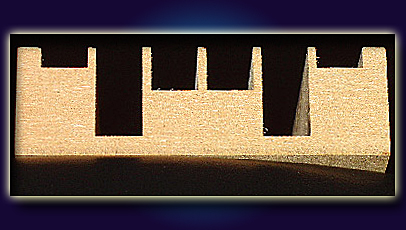 QRD-7 strips (HDF) to eliminate flutter-echo
or embedding in fractal diffusers
both products have identical specs
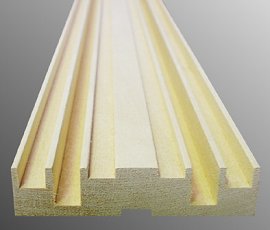
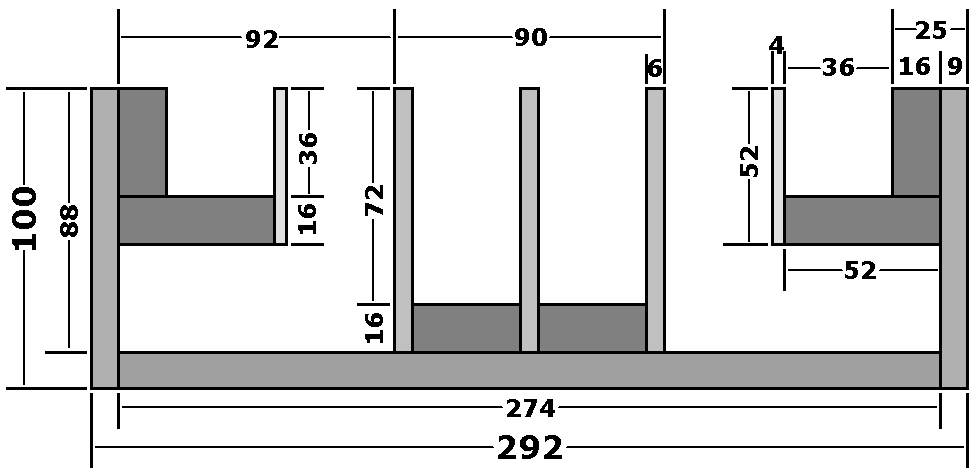
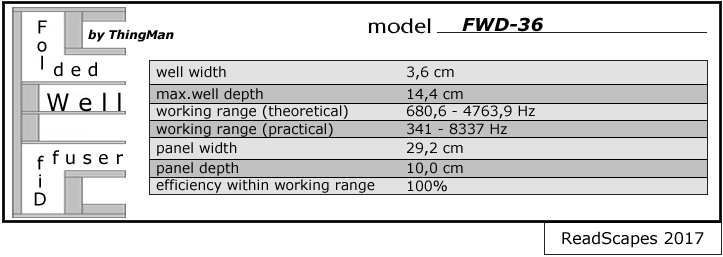
above: QRD-7 plan and profile (dimensions in mm)
The example plan above deals with allround QRD-7 diffuser FWD-36.In an allround diffuser the maximum well-depth lies somewhere between 14 and 21 cm, resulting in a bottom-end frequency limit somewhere between 225 and 350 Hz, well into the lower part of the fundamentals range. The corresponding well-width lies between 3,5 and 5,5 cm, resulting in a top-end frequency limit of 5 to 8 kHz.
There is
no real advantage in the application of diffusers with a range far exceeding the upper limit of the fundamentals range (up to 4,1 kHz). 8kHz would really be the practical top-end here.
**A higher top-end limit of the working range is of no advantage, and this is even more so because the low-end of the range will also shift upward, which is not a good thing either. The more the working-range corresponds to the fundamentals range, the more “allround” a diffuser will be.**
As we’ve already seen, a very high top-end of the range renders the diffuser more and more useless** as a diffuser as it more and more turns into an anti-flutter strip.
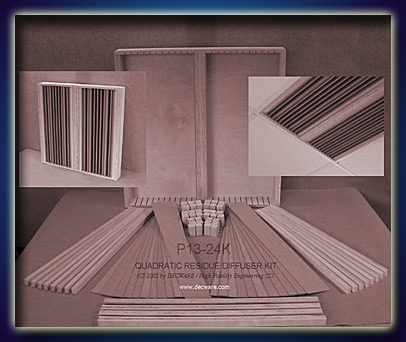
The photo below is quite interesting. It shows the only diy-diffuserkit I have ever come across on the internet, apart from the WaveWeaver-kits offered by SoundScapeS between 2010 and 2014. Commercial kits were never that attractive, or so it seems…
The price of this kit below is, still, very high (
**to Dutch standards***), with a considerable three-digit price tag…
However, the price per square meter commercial and ready-built diffusion is even much higher:
**depending on the chosen finish, 1 square meter of commercial diffusion **will cost between 650 and 1500 euros.
And we haven’t even discussed fractal diffusion yet…
Fractale QRD-7I’ve mentioned so-called “fractal diffusers”several times now.
**Have a look at the photos on the right and the drawing below.
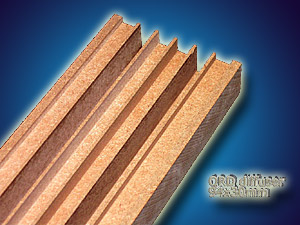 **A fractal diffuser is essentially a normal QRD. Instead of a each well having a flat well-bottom, a correctly scaled mini-QRD is embedded and serves as the bottom of each well in a fractal diffuser.
Such a “mini-QRD” is usually cut from massive HDF profile, as you can see on the right.
Fractal diffusion is a bit like the russian matrouchka dolls: each doll has a slighly smaller replica embeddid inside, and so on…
Fractal diffusion might be called: 2-way or even 3-way diffusion. The top-end of the larger diffuser should about equal the bottom-end of the embedded element.
The drawing below illustrates
multiway fractal diffusion.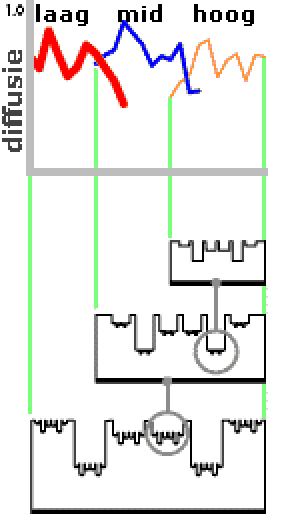 **
**
A fractal diffuser will have a far extended top-end frequency limit compared to an identical QRD without embedded QRD-strips.The Diffractal by RPG, shown on the right, homogenously diffuses the soundfield up to 25kHz. because of the embedded QRD-strip.
The**bigger **diffuser will have a working range that starts as low as 250Hz.
This implies that a**“2-way diffuser” is already capable of covering almost **the entire audiospectrum!
You may expect that a real
3-way diffuser,* as shown on the left, would truly cover the entire spectrum, as the biggest **of the 3 diffusers starts working around 50Hz.
The working range of a fractal 2-way diffuser covers almost twice the width of a single QRD: 3,75 versus 6,5 octaves!
But as you know by now, even a single QRD**with a well chosen working range will do a very good job, yet at a fraction of the price of fractal diffusion.
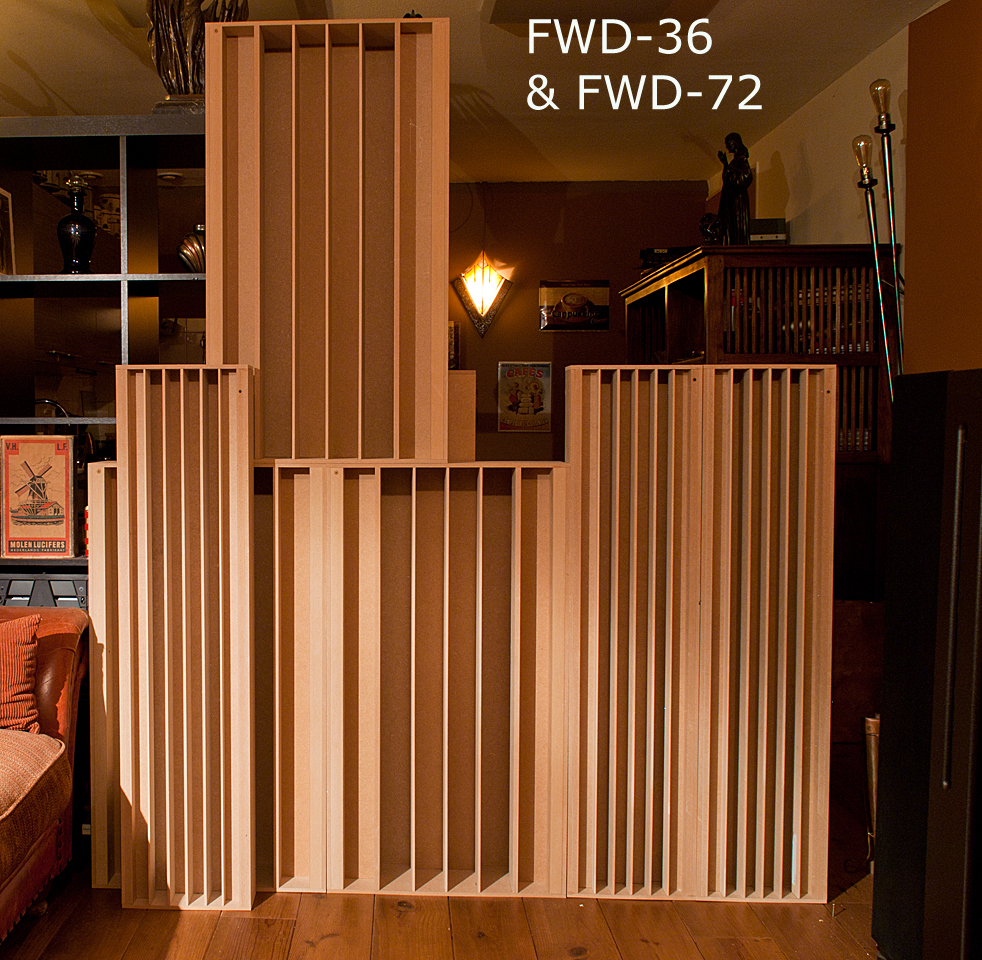
above:
allround QRD-7 model FWD-36 and bottom-end diffuser FWD-72 (well-width 36 and 72 mm)
in which the deepest wells have been folded once.**This ‘trick’ allows you to realise** **the lowest possible bottom-end combined with minimum diffuser depth and use of materials.*
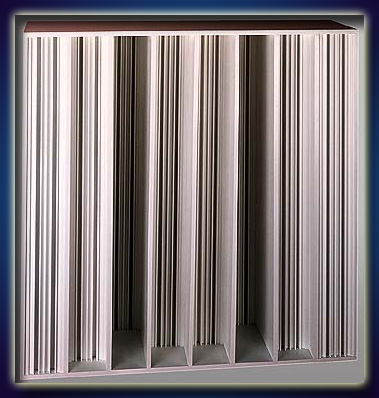 above: a commercial fractal QRD-7 diffuser, the RPG “Diffractal”*
size: 61 x 61 cm
in each of the 7 wells a small and scaled “mini-QRD” is embedded.
price, ex works (no transport): ± 500 dollars for untreated mdf finish
other finishes add to the price***